
Sheikh Maqsoud Dispatch
Notes and photographs from a recent walk though the former SDF enclave
This is the latest in a series of writeups following trips of mine to areas covered in the newsletter. This one is rather brief and surface level, the result of a walk through Aleppo’s al-Sheikh Maqsoud and al-Ashrafiyah neighborhoods on the afternoon of May 22nd, and will be followed shortly by an Afrin dispatch. Going forward I hope to spend more time traveling around northern and eastern Syria and to further develop the research element of these posts. Previous dispatches are available on a newly created ‘Dispatch’ page, visible on top menu.
Al-Sheikh Maqsoud sits in northwestern Aleppo, less than three kilometers from the city’s central al-‘Aziziyah neighborhood. I set out by foot from there, passing over the Quweiq river and under the railroad tracks, stopping first in the Old Suriyan neighborhood to meet a friend who would be joining me. This friend, originally from Afrin, grew up in Old Suriyan and recently moved back after spending over a decade abroad.
The five neighborhoods that make up this northwestern corner of Aleppo, al-Sheikh Maqsoud, al-Ashrafiyah, Old and New Suriyan, and Bani Zaid/al-Rusafah, are the products of twentieth century population displacement and economic migration. Located on the other side of the train tracks from Aleppo’s wealthier Christian neighborhoods, Old Suriyan was founded by Syriac (Arabic: Suriyan) refugees pushed out of Urfa/Edessa as part of the anti-Christian genocides perpetrated by the Ottoman state in 1915. During the mandate period various Christian communities also settled in the more remote and hillier areas to the north, then known as Jabal al-Sayyidah, now al-Sheikh Maqsoud.
Note: Bani Zaid/al-Rusafah did not come up in my discussions nor my prior research so will have to be addressed at a different time.
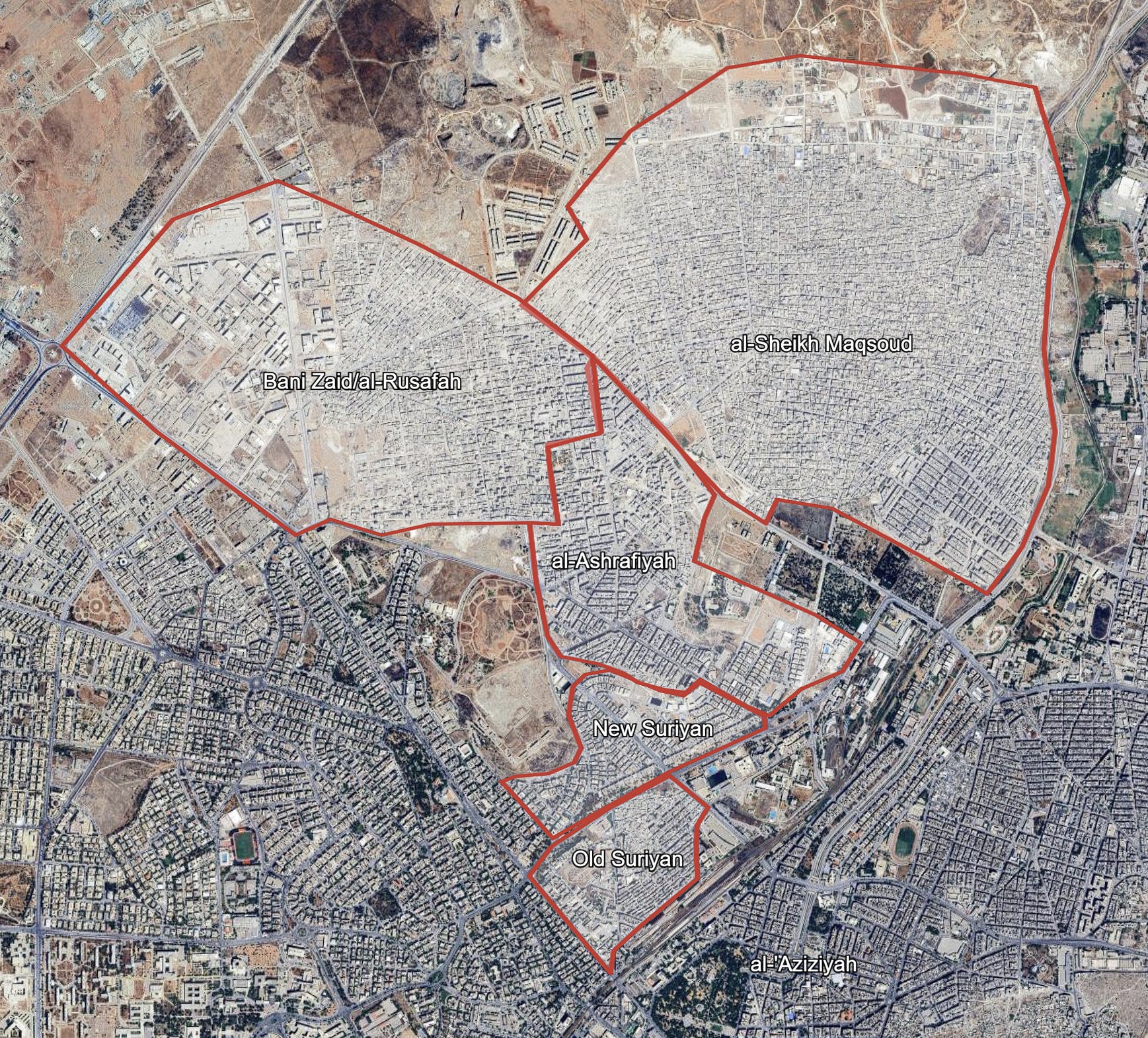
In the ensuing decades Kurds from Afrin and Kobani, as well as Arabs from other parts of the Aleppo countryside, began moving to these areas as they sought employment in Syria’s industrial capital. The neighborhoods of al-Ashrafiyah and New Suriyan, located between the two older districts, began to develop in the late 1950s.
Today, with its broad streets and modern apartment buildings build in 1970s or 80s, New Suriyan represents the wealthiest of the four. At the other end of spectrum is al-Sheikh Maqsoud, which largely lacks services and contains a significant amount of unzoned (ashwa’i) housing stock due to perennial neglect by the state. Al-Sheikh Maqsoud remains the most Kurdish of these areas while Old and New Suriyan are quite demographically mixed, featuring Syrians from Aleppo and its countryside as well as populations from further afield including ‘Alawis from the coast.
As explained to me by this friend from Afrin/Old Suriyan, who prior to the war had family residing across this area, Kurds from Afrin first move to al-Sheikh Maqsoud with the aspiration of moving down the hill into al-Ashrafiyah and Old or New Suriyan.
